



Merle Randlepp
Agile Coach
Merle Randlepp
Agile Coach
How to measure the work of a Scrum Master?

Photo by manfredsteger
How can you tell if the Scrum Master of a development team is doing his job well? I’ve heard various exciting answers such as “Well, the team members are happy with him” and “He spends little time in meetings and is therefore efficient”, etc. The work of a Scrum Master cannot be judged simply on the basis of a few numerical results, but I will give you 5 main success criteria to follow.
Self-acting team
Many teams start their agile journey by coming from a command-and-control environment where they were always told exactly what to do and how to do things. The first task of a Scrum Master is to change the behavior patterns and mindset of team members so that the team is independent in its daily work and operates autonomously. An agile team must cover all the roles needed to make day-to-day development decisions and solve problems. The team must have a product owner, designer, analyst/architect and other necessary technical expertise so that the team can function as a unified team (T-shaped team).
An agile team is not managed from outside the team in its day-to-day work. A well-functioning team knows its goal and roadmap, users’ wishes and feedback at all times, and the team also has the necessary skills and the right to make current decisions themselves.
If the Scrum Master has been able to create a self-functioning team that makes its daily decisions on its own, then the first and most important goal of his or her work has been achieved.

Photo by KeithJJ, author
Continuous learning and development
One of the main characteristics of an agile team is consistent learning and experimentation. And it is important to learn together and with a team, individual learning is part of everyday work these days anyway. If a team does not have the opportunity to regularly evaluate itself as a unified team and realize the potential for development, the result is a status quo and a team that stands still in development.
The task of the Scrum Master is to conduct regular retrospective meetings, where the team discusses how they can be better at their work, what are the current problem areas, what new approaches and practices should be tested. At the end of the meeting, it is agreed what will be the focus of the next sprint in order to improve the work process, and at the next meeting, they look back and assess how it went.
Continuous development from the perspective of both the team and the individual gives team members a powerful motivational injection, not to mention becoming more efficient.
A team that is constantly learning, experimenting and developing is a direct result of the successful work of the Scrum Master.

Sailboat Retrospective Board. Photo by Author
The right goals
We all need goals to move towards. The goals must also be suitable and meaningful for us on a personal level. Each team member must have a full understanding of where and why they are moving together.
The Scrum Master’s task is to contribute to goal-setting in every way. Their job is to implement an agile mindset that has a clear focus on value creation. Unfortunately, there is still a lot of “Feature Factory” style development in software development, where the focus is on creating as many features as possible (and collecting story points), while forgetting to check what the end users really want.
If the team knows and keeps in mind the goals based on the interests of the end users, the Scrum Master’s job in this paragraph is well done.

Photo by eprins67
Tidy Product Backlog
A tidy Product Backlog means a list of tasks from which the members of the development team can pick the next job at any time, the business needs of which are thoroughly described. This means that the backlog must be prioritized by the Product Owner, the work at the top of it has been discussed, approved and is fully prepared for work. Unnecessary and outdated work has been removed from the backlog by the Product Owner, because an active Product Backlog must not be a garbage dump for years.
Although the lion’s share of Product Backlog management is done by the Product Owner, it is the task of the whole team, not just the Product Owner, to constantly update and maintain it. The Scrum Master’s task is to support the product owner and make working with the Backlog a natural part of each team member’s daily work.
A well-maintained Product Backlog and enabling a smooth development flow for the team are one of the hallmarks of a Scrum Master’s job well done.

Photo by PublicDomainPictures
High product quality
Striving for a consistently more efficient development process and keeping attention to the quality of development is also part of the work of a Scrum Master. The basis for high software product quality is both purposeful value creation and minimal technical debt.
The right development methodology is also important. At the beginning of the agile journey, the Scrum Master must help the team choose a methodology based on the goals and the content of the project. Scrum is not suitable for everyone, and there are many different agile methods. Perhaps there is no need to use an empirical process at all in this project? Stacey Matrix and Cynefin Matrix help make this decision.
One of the characteristics of a Scrum Master’s good work is the team’s efficient development process and the creation of a high-quality product.
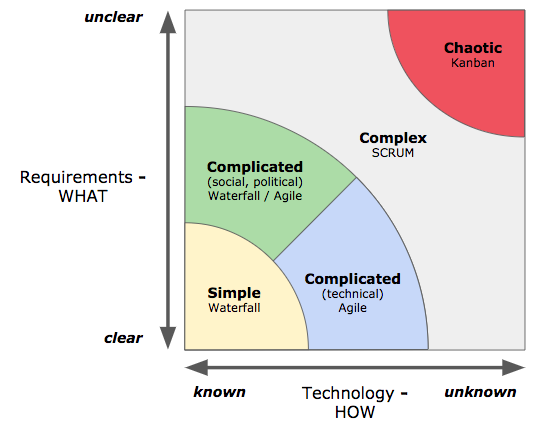
Stacey Matrix [Stacey 1996] adapted to software development. Photo by Agile-Minds
How not to measure the work of a Scrum Master
Some examples that should definitely be avoided when evaluating the success of a Scrum Master’s work:
- Number of sprint velocity points
There is a great danger here that it will quickly become the aforementioned featture factory. Besides, the size of each team’s story points is different and it would be very foolish to judge the success of different teams based on the points completed during the sprint. - Number of features in the sprint
The same reason as in the previous point. The number of features does not indicate whether a product of value to the user was created at all. - Stay on schedule and on budget
End users don’t use the product because with the help of Scrum Master, the development stayed on schedule and on budget. The end user uses the product because they like it and it meets their needs. - Team member satisfaction only
Of course, team satisfaction with Scrum Master is important, but taken alone, it is not a very competent and objective metric. In the role of a Scrum Master, you can be a pleasant and humorous person who is always pleasant to communicate with and who is there for you, but whether they actually create real results in the development of an agile team is a completely different topic.

Photo by Tama66
Summary
The Scrum Master’s job is to help the development team fulfill its main goal – to create a valuable product for the end user that is of high quality and delivered regularly.
The result of Scrum Master’s work can best be measured by the performance of the team:
- Is the team self-sufficient?
- Is the whole team constantly learning and developing together?
- Are the right goals being pursued?
- is the Product Backlog in order and of high quality?
- Is a high-quality product being created?
If all the answers in your team are “Yes” or “Almost”, you have a reason to take a surprise cake to your Scrum Master tomorrow 🙂 Your team is moving in the right direction!
Related topics
How to conduct a Scrum Retro meeting?
I am often asked how to conduct a Scrum Retro meeting correctly so that people would be happy to participate next time as well. And this is a very correct question, because if you conduct a Retro meeting in an incompetent way, it will most likely go wrong and people will have a traumatic experience instead of the expected benefit. However, a successful Retro meeting is extremely useful. Here you will find a detailed step-by-step description of how to carry out your first Retro or, if you have already done them before, you may find new useful tips.
What is the Knoster Model and what is it used for?
The Knoster Model [1] is a simple and powerful tool for those who need to manage important changes – project managers, team leaders, company leaders, etc. The model is useful if you want to understand how people psychologically adapt to change and how they cope with major changes in everyday life.
Agility enthusiasts in Estonia
Here is a brief overview of the agility-related communities, service providers and trainers in Estonia that I know of at the moment.


Every new contact is an opportunity for new and exciting collaboration - write or call me, and let's discuss how I can help you.
The first consultation and proposal are always free.
0 Comments