



Merle Randlepp
Agile Coach
Merle Randlepp
Agile Coach
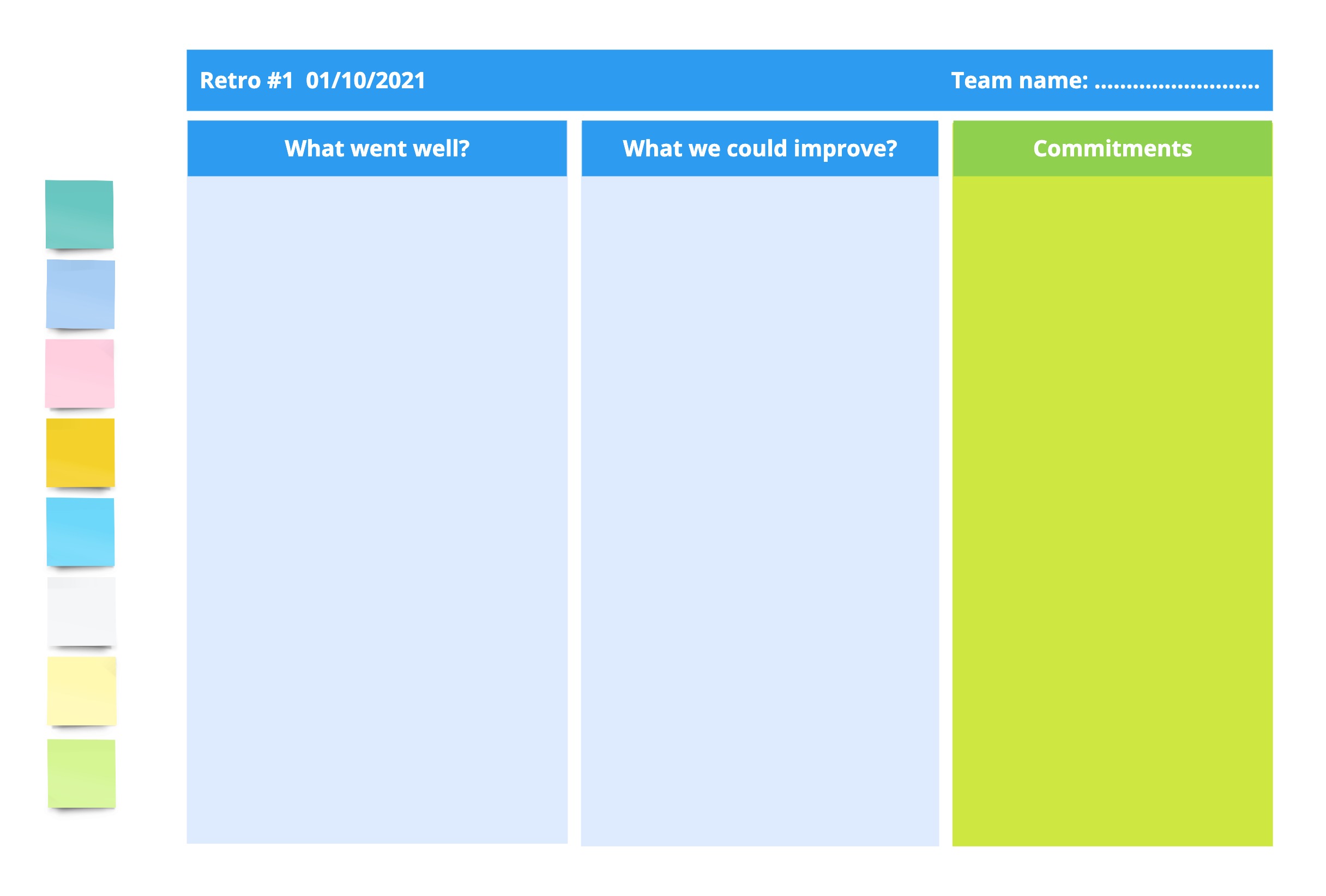
Scrum Retro Classic Board, Author’s Image
I am often asked how to conduct a Scrum Retro meeting correctly so that people would be happy to participate next time as well. And this is a very correct question, because if you conduct a Retro meeting in an incompetent way, it will most likely go wrong and people will have a traumatic experience instead of the expected benefit. However, a successful Retro meeting is extremely useful. Here you will find a detailed step-by-step description of how to carry out your first Retro or, if you have already done them before, you may find new useful tips.
Wait, what a Retro meeting?
“Retro” in software development does not mean nostalgic retrospective, but is an abbreviation of the term “Sprint Retrospective” in the Scrum framework , which refers to a joint meeting of the team with the aim of analyzing the previous work segment (sprint) and thinking about what could be done better. In Estonian, the translation “retrospective meeting” is also used, but “retro” is more palatable and more common.
Today, Retro meetings have spread much further away from the IT world – wherever it is necessary to discuss problem areas with the team and find solutions to them, “Retro” is done. There is a simple reason for such great popularity: The retro format is simple in nature, effective and always leads to results. However, this does not mean that managing a Retro meeting itself is always easy.
I recommend every team starting an agile journey to take regular Retro meetings as the first step. Their efficiency is powerful and people can see it quickly.

Photo by Pixabay
What a Retro Meeting Is Not
Let’s talk about the risks first. If the Retro meeting is not consciously managed and the neutral format is not followed, there is a good chance that in case of painful problems, people will simply start venting and blaming each other indirectly or even directly. The thin layer of professionalism disappears in a matter of minutes and the result is conflict in the collective.
On the other hand, if there is a lack of trust and a closed atmosphere, it may happen that no one dares to bring any real problems to the table, and so they talk about nothing. Again, no benefit to anyone.
A retro meeting is neither a place to find and hang culprits, nor a place for a free microphone in any direction. The goal of retro is to bring problems to the table in a neutral way and find concrete solutions to them together.
Who is leading the meeting
In software development, the Scrum Retro meeting must be led and moderated by a person in the role of Scrum Master or someone who is well versed in agile principles and conducting Retro.
In other areas, it can be the convener and organizer of Retro, but it would be better if the role of leading the meeting was not performed by the leader of the participating team. It is enough that the facilitator has good knowledge of the principles of Retro (you can find them in this blog post) and good communication skills.
The skills required are:
- strictly adhering to the time frame and managing the meeting in such a way that it always reaches a specific end and is not interrupted due to lack of time;
- good communication skills and the ability to politely interrupt too long a flow of conversation and move on, if necessary;
- a positive and constructive mindset to engage and encourage everyone to express their opinions and think along.
To keep the meeting within the agreed time frame and be manageable, try to limit the number of participants to a maximum of 10 people, at most 15.
Preliminary work before the meeting
The Scrum Master will do the groundwork (I will refer to this role as the Retro facilitator hereinafter, even if it is not an IT company) and I will direct the rest of the conversation directly to you – you, the Scrum Master. In fact, you are responsible for organizing the entire Retro from start to finish. Of course, if there are also some pizzas or other food and drinks planned, then maybe the office fairy will help with the organization 🙂
If it’s a virtual meeting, I recommend using an online whiteboarding tool like Miro. (Among the templates of Miroverse, you can currently find 49 different templates by searching for “retro”, you can start with the simplest, e.g . https://miro.com/miroverse/run-a-retrospective/)
If you meet physically in the same room (always the best option!), then all you need are stickys, pens and a whiteboard or some wall space.

Photo by Pixabay
Step One – Introducing the Retro Purpose
If this is your team’s first Retro meeting, then the Scrum Master must first explain the purpose of the meeting, what it is useful for, and what the results of the meeting will be. Talk about how important it is for every person to develop and move forward, because we all want to move to the next level of development (ok, a tiny percentage doesn’t care, but don’t focus on them). It is important to develop as a team, not just as an individual. Also note how important mutual respect is even in emotionally critical situations.
Here is a little help to make it easier to get on the road:
- Retro purpose: Map the team’s strengths and bottlenecks together. To rejoice in strengths and find solutions to bottlenecks together. To be in the same boat together and work towards a common goal.
- Retro Utility: Teams need time and a place to analyse their work and find development opportunities to become better. We put a lot of emphasis on WHAT we made, but too little emphasis on HOW we did it.
- Retro outcomes: mutually agreed concrete actions that need to be implemented in the near future. To ensure that the activities do not fall off the table, the Scrum Master keeps an eye on them and supports them if necessary.
Consistent organization of Retros guarantees not only the continuous development of the team, but also an overall increase in motivation and team spirit. Good Retros are expected.
Then draw a Retro Board on the board (or open the corresponding template in Miro), explain the content of 3 columns one by one:
- What went well,
- What we could improve,
- Commitments (or Action Points).
Scrum Retro Classic Board, Author’s Image
Step Two – Silent Analysis
Distribute stickies to each participant (in the virtual room, ask everyone to choose their own sticky color). Ask everyone to write down the good and positive things they can be proud of and the problems that need to be solved. One idea on a sticky. If there are many participants (around 7-10), it is reasonable to limit the number of thoughts – e.g. 3 positive thoughts and 3 problem areas. It helps to stay in the time frame.
Give about 5 minutes for quiet writing.
It is very important that you do not fill this quiet time of reflection with your own talk, but let a comfortable, analytical, contemplative silence arise. People just can’t concentrate when someone is chatting 🙂

Step Three – Sharing Your Thoughts
When everyone has written their thoughts on the sticky, the circle of sharing thoughts begins. Ask each participant to take turns standing up, bring their sticky, and come to the board (or take over in a virtual meeting). Ask to put sticky in the “What went well” column first and then in the “What we could improve” column. With each sticky , everyone says briefly (2-3 sentences) what it is and why it is important to them.
Once one participant has put all their stickys away, the next one continues.
At first, ask to refrain from long talk with each sticky , group discussion, big comments and offering solutions (this tends to happen automatically). Say that the time for discussion is still coming, for the time being we will only LISTEN to the thoughts.
As a Scrum Master, moderate the flow of conversation here quite strictly, keep the atmosphere of listening and do not move into the atmosphere of discussion yet. This way, all listeners have time to get used to what they hear, collect their thoughts and maybe cool down a bit 🙂 Individual remarks and consents are good, but a longer discussion should be politely interrupted.
Step Four – Grouping
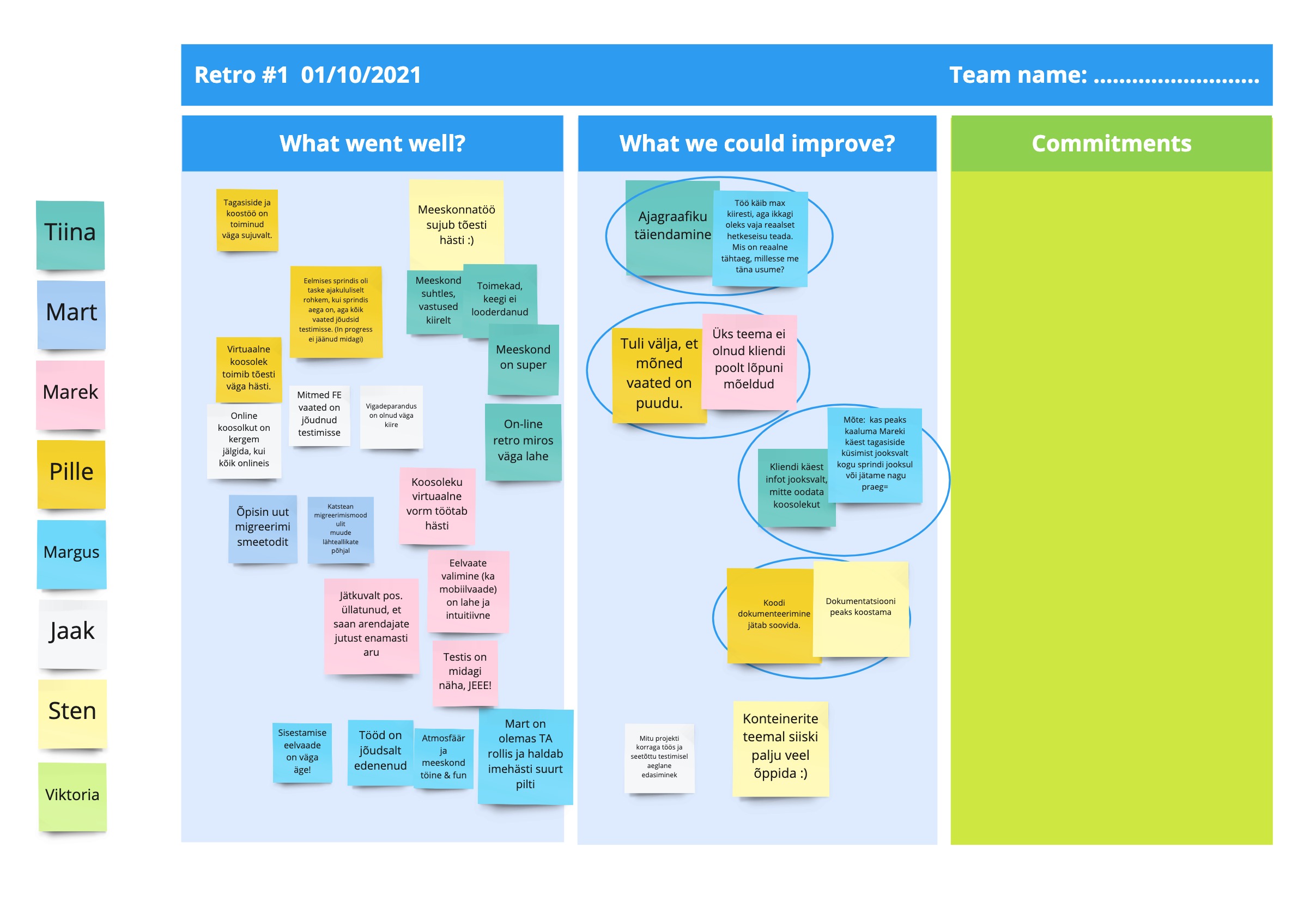
Once all participants have put their stickies on the board, take it upon yourself to group them. Visually combine recurring topics into a common group (hence the principle “one sticky = one thought” – this is a good way to move them) and try to find a common name for the group. Visually draw a line around each group so that they are clearly distinguished.
Do this by talking and introducing topics, spend enough time acknowledging the positive moments, and be proud of how awesome a team you are.
The grouping activity takes some time and concentration, especially if there are a lot of stickies, but involve the rest of the team in your activities and you will be able to do it faster. The grouping step should not be skipped and it is always useful to do it. As a result, you get a series of topics, where one group = one topic.
Creating a positive and appreciative atmosphere at this stage is the foundation for Scrum Retro’s success. We build trust and a shared team spirit, and then we focus on solving problems in this atmosphere of trust and calm.
Author’s image
Step Five – Voting
Introduce your team to a common voting technique – “dot voting“. Each participant has a certain number of votes (e.g. 3) and can distribute them per topic/group as they see fit.
Ask everyone to cast their votes. Voters can cast all their votes on one topic or divide them between different topics as they see fit.
It is reasonable to give a small number of votes to be shared, so that there is a so-called difficult moment of choice, which helps to distinguish the important from the insignificant. At the same time, if there are more topics or fewer participants, you can easily cast more than 3 votes.
In a face-to-face meeting, points can be given simply by marking points on sticks with a pen or you can use stickers (sold in office supplies).
On the Miro board, you can use either the Miro Voting feature (you give a timebox and Miro counts the votes itself) or a less automatic version – each person has one point for each vote that they can drag to the stickys.
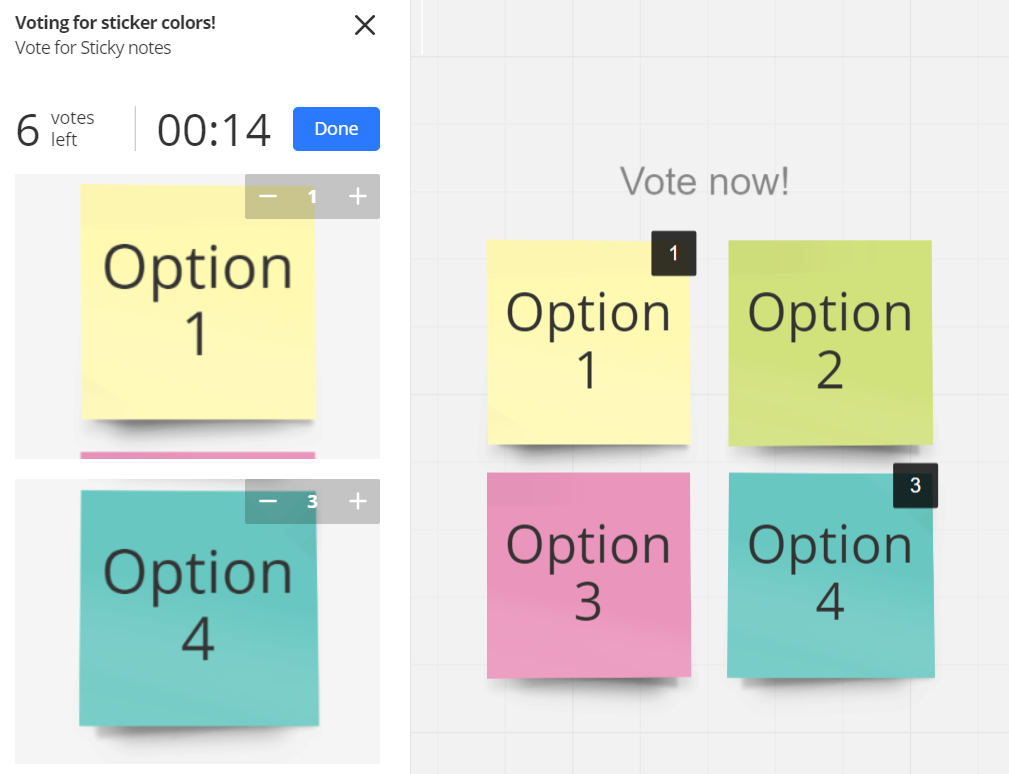
Photo by Miro
Step Six – Discussion and Finding Solutions
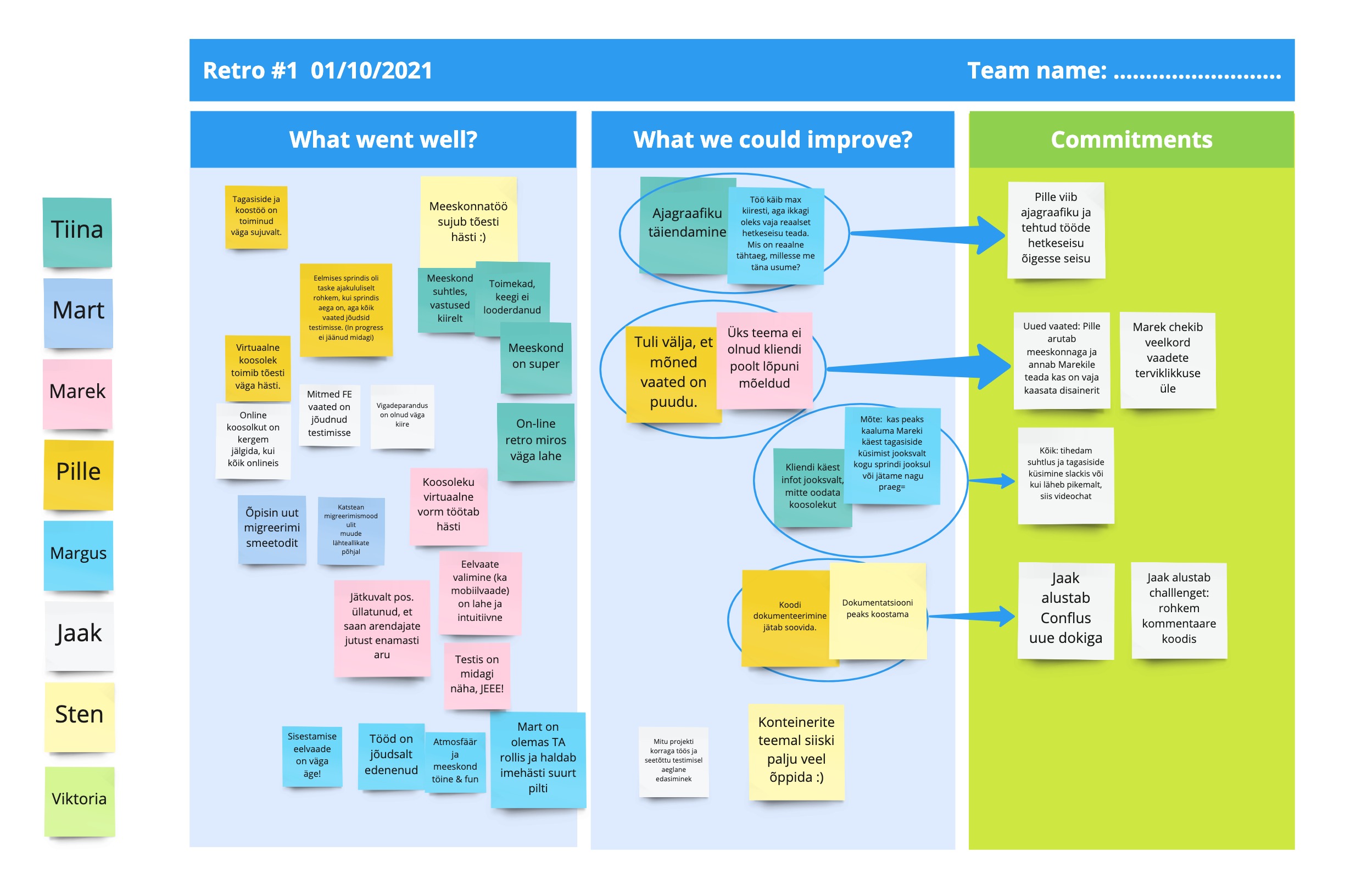
Count the votes for each topic, mark the number of votes on the board and start the discussion with the topic with the most votes. Encourage everyone to express different opinions on what could be done to solve this problem and listen carefully. Direct the team to find a consensus and choose one activity. Write this action (or promise) in the third column, “Commitments.” Don’t forget to add a person in charge, sometimes it’s the whole team, sometimes a specific person.
Take the topic with the next largest number of votes and repeat the process.
Constantly monitor the time frame of the meeting, moderate the discussion and leave topics with a smaller number of votes not worked through at all – they may just be for information.
I’ve seen retros where the Scrum Master lists 14(!) different activities for the team – be nice and do it all in the next 2 weeks! Don’t repeat this mistake and choose a maximum of 3-6 activities that you can realistically do in the near future. Less is more.
Author’s image
Step Seven – Retro Summary
So, the bigger work is behind us and it’s time to make a Retro summary. Recall once again the good and positive moments that were brought out in retro and that you are all proud of. Briefly review the activities you have agreed on and be enthusiastic and supportive of their implementation. You can do it!
Make a promise to keep your finger on the pulse and be responsible for not forgetting your activities and falling off the table.
End the meeting and send the participants on their way with the message that in a while you will do the next Retro, where you will look back at how it has gone and take on new challenges. Be positive, it’s contagious!
No one should leave Retro (especially on a Friday night) in tears and feeling terrible. Scrum Master, this is your responsibility.
Finally, record the Retro results and take a quick screenshot of the tablet or a photo with your mobile phone. Don’t waste too much time on fixing, a quick click is quite enough. But don’t skip this step under any circumstances, because continuous progress and fixing it is important.
What happens next?
If you feel that Retro was a success, immediately schedule a regular Retro time for the team in your calendars (usually more than 2 weeks) and send out the invitations. But if you feel that something went very wrong right away and the atmosphere only got worse, then seek help and don’t do the next Retro until you are very well prepared for it. If you feel “so-and-so”, then be brave – next time you will be more experienced and Retros will be more and more successful!
Between the two Retro meetings, your task as a Scrum Master is to fulfill your promise to keep your finger on the pulse and remind the team of the promises if necessary. Be polite and supportive (servant leader) when doing this, do not choose a command&rsquos approach under any circumstances.
The next Retro begins with a review of the promises of the previous Retro. It is very okay if it takes longer to solve more difficult problems. It can take several, many Retros. It is important to be consistent and keep track of whether the team is standing still or constantly moving forward on its development path.
Experiment with different formats
If you are already familiar with the classic Scrum Retro format described above, feel free to experiment with different formats. You can find a large selection of ideas for conducting Retros and better involving people here: https://www.funretrospectives.com/.
For example, the Sailboat Retro format is very common, which I often use with beginner teams:
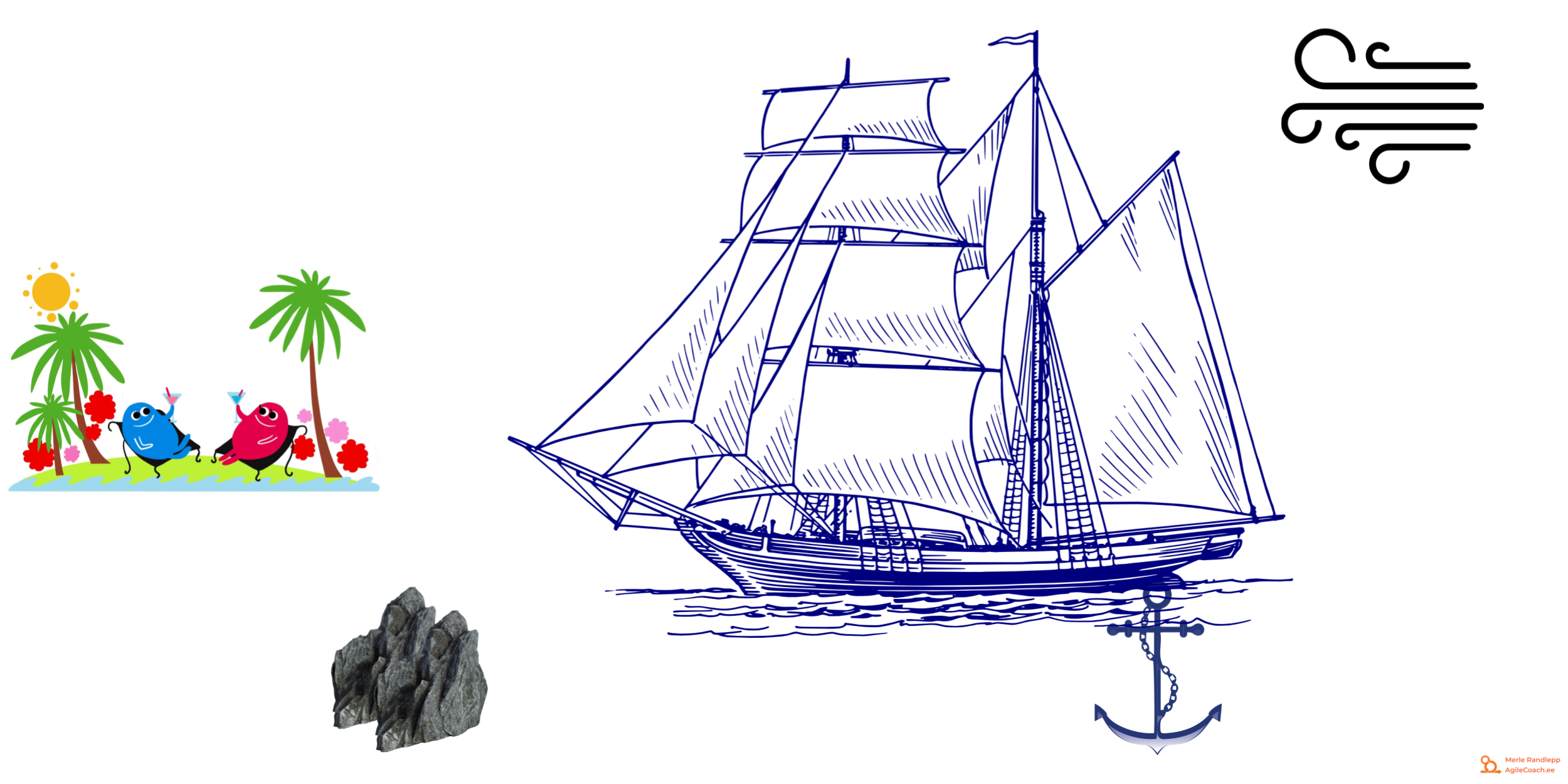
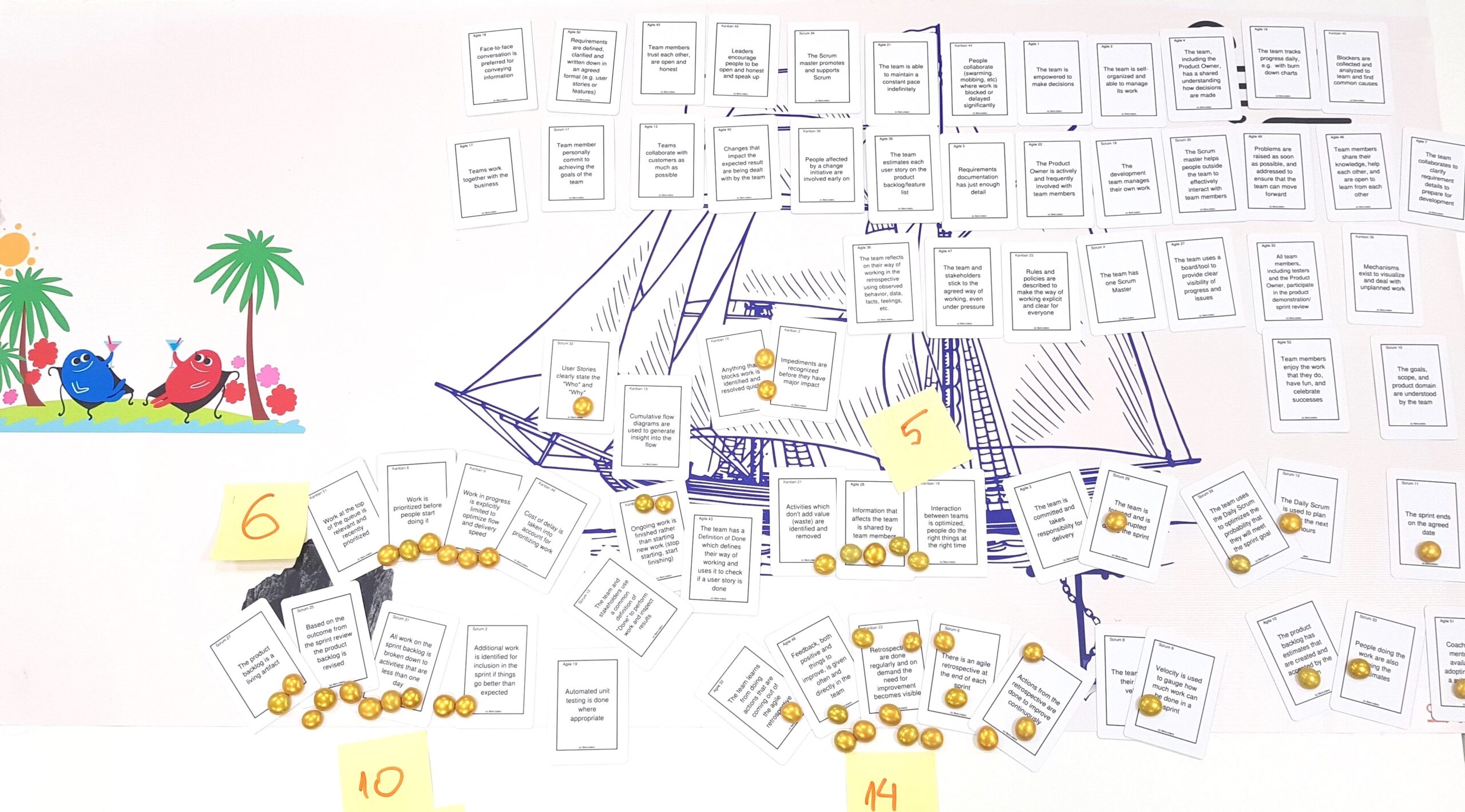
Author’s image
Summary
Every team that wants to constantly improve uses Retro meetings in one format or another for that. A retro meeting is a place where we can discuss together how we can work better together, develop as a team, and in the process, motivation also increases. Meetings should be held regularly, preferably every time on the same day and at the same time, the best frequency is once every 2 weeks. The meeting must be conducted skillfully, and in software development, this is done by a person in the role of a Scrum Master. Each meeting must end with a list of specific activities that will be carried out together. The activities should be so small in volume that they can realistically be done before the next Retro and there shouldn’t be too many of them at once.
A well-conducted Scrum Retro meeting has an open atmosphere, is energetic, stays within the time frame, is beneficial for everyone and fun for the team 🙂
Scrum Master, I wish you success!
Related topics

How to measure the work of a Scrum Master?
How do you know that the Scrum Master of the development team does his job well? The success of a Scrum Master’s work cannot be judged on the basis of a few numerical values, but I will give you 5 main success criteria to follow.
What is the Knoster Model and what is it used for?
The Knoster Model [1] is a simple and powerful tool for those who need to manage important changes – project managers, team leaders, company leaders, etc. The model is useful if you want to understand how people psychologically adapt to change and how they cope with major changes in everyday life.

Agility enthusiasts in Estonia
Here is a brief overview of the agility-related communities, service providers and trainers in Estonia that I know of at the moment.


Every new contact is an opportunity for new and exciting collaboration - write or call me, and let's discuss how I can help you.
The first consultation and proposal are always free.
0 Comments