
Who is an Agile Coach
Agile coach: The individual is an agile expert who provides guidance for new agile implementations as well as existing agile teams. The agile coach is experienced in employing agile techniques in different environments and has successfully run diverse agile projects. The individual builds and maintains relationships with everyone involved, coaches individuals, trains groups, and facilitates interactive workshops. The agile coach is typically from outside the organization, and the role may be temporary or permanent.
― Scott M. Graffius, Agile Transformation: A Brief Story of How an Entertainment Company Developed New Capabilities and Unlocked Business Agility to Thrive in an Era of Rapid Change
What does an Agile Coach do
Let’s start with what an Agile Coach is not. They are not:
- business coach (business coach)
- personal coach (personal coach)
- therapist
- only a professional coach (professional coach)
- only a consultant
An Agile Coach is able to change their role according to the situation (often even within a single coaching session) and alternately take on one of these roles:
- mentor
- trainer/teacher
- consultant or advisor
- professional coach
- facilitator (facilitator)
- evangelist (who inspires and motivates)
- etc.
Therefore, the role of an Agile Coach is very different from that of a classical coach. Of course, the domain is also different – an Agile Coach focuses on guiding and assisting an individual’s/team’s/organization’s agile journey.
The role of an Agile Coach requires deep knowledge of agile practices, models, tools, as well as team and organizational management and models, and much more. This knowledge is accumulated over a long period through experience and continuous learning.
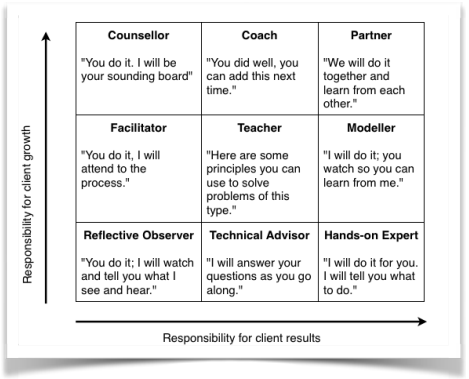
9 different roles
An Agile Coach switches between different roles as needed – depending on the client and the situation. It is important to be aware of which roles you are currently fulfilling as an Agile Coach and why.
I personally most often find myself in the middle column – Coach, Teacher, and Technical Advisor, but of course, all nine are occasionally needed.
Facilitator, Counsellor, and Coach create more value in the long run because they give the client the tools and the ability to do things themselves.
Modeller, Hands-on Expert, and Technical Advisor have a shorter impact because the client is told more explicitly what to do. But these are also sometimes needed.
What an Agile Coach should know
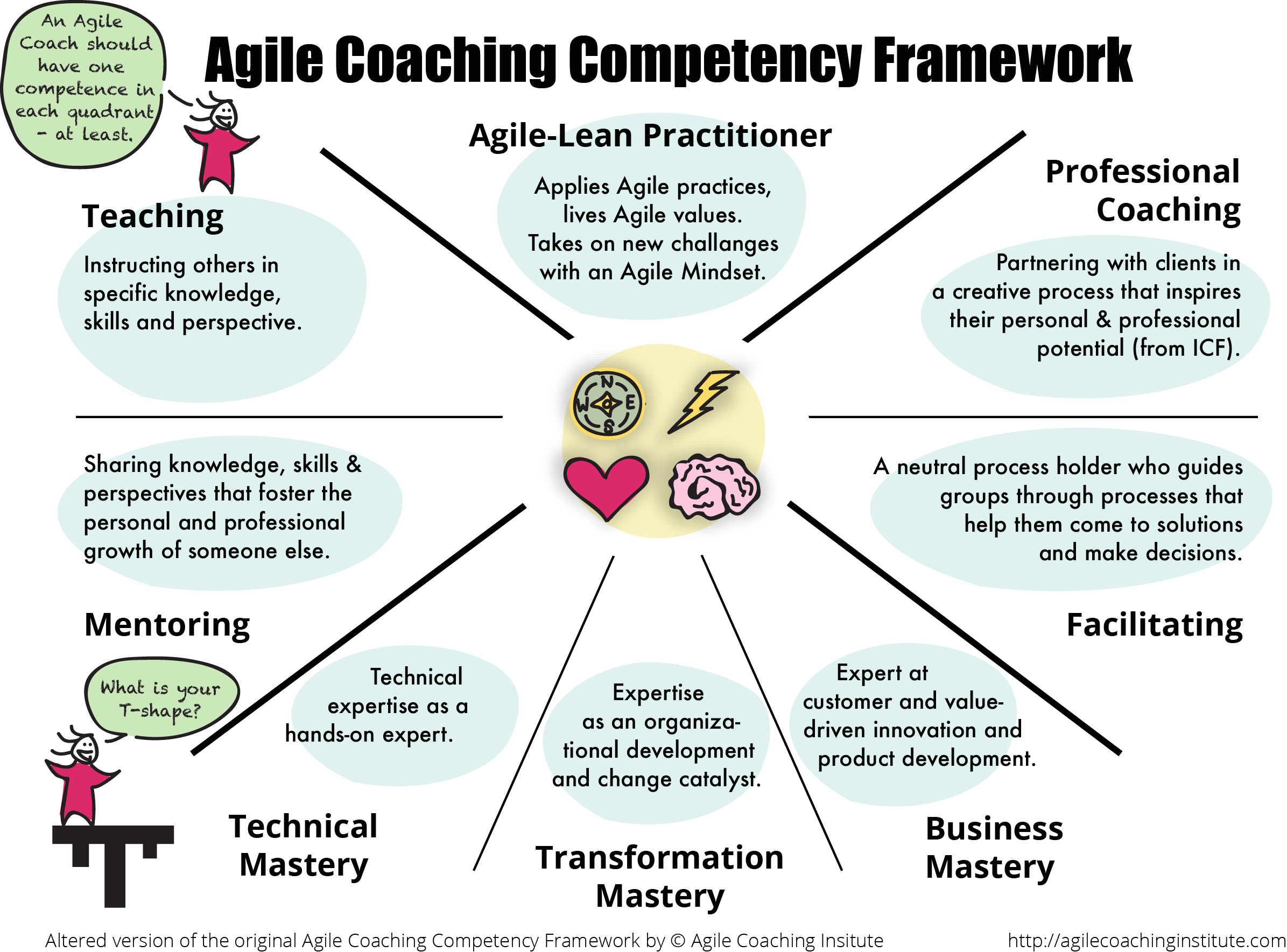
Every Agile Coach should know and have used the tool Agile Coaching Growth Wheel, which helps to perform self-analysis and map out one’s strengths and identify skills that need further development.
An Agile Coach must be an expert in several different areas, both technical and in the field of classical coach’ing. An overview of the main competencies is provided by the framework below, which has four main divisions. An Agile Coach should have at least one competency in each quadrant.
Learn more at https://dandypeople.com/blog/agile-coaching-in-a-nutshell/
Frequently Asked Questions
What is the difference between a Scrum Master and an Agile Coach?
Generally, these are similar roles, as both are responsible for implementing agile mindset and practices. Every Agile Coach has once started in the role of a Scrum Master. The main difference lies in the scope of action, experience, and area of influence:
- A Scrum Master works permanently in one or a maximum of two to three teams, knowing all team members and the project inside out. An Agile Coach, however, often operates with a broader scope, working with more teams and with management.
- An Agile Coach collaborates closely with the Scrum Masters of the teams; these two roles complement each other on the agile journey.
- An Agile Coach has at least 5+ years of experience, working with various agile frameworks (Scrum, Kanban, XP, Lean, LeSS, etc.)
- In addition to supporting teams, an Agile Coach focuses more on implementing the agile working method within the organization.
- An Agile Coach can be internal and work permanently within one organization, or be an external expert who is engaged for a specific purpose for a certain period.
What is the role and responsibility of an Agile Coach?
- Raise the awareness of different teams and individuals regarding their strengths and weaknesses, to facilitate their journey towards an agile mindset.
- Guide and help select the next steps to maximize the benefits of agility.
- Foster healthy group dynamics
- Offer new tools and techniques (e.g., for workshops, agile planning, etc.).
- Help scale the agile model and ensure smooth collaboration among agile teams within the organization, using, for example, Scaled Agile Framework (LeSS, Nexus, etc.).
What is Scrum?
Scrum is an agile development framework that divides large processes into small pieces to increase efficiency and relies on effective teamwork and the creation of high value.
Scrum is widely used as a software development methodology, enabling the creation of products with maximum creativity and efficiency.
What are Scrum Values?
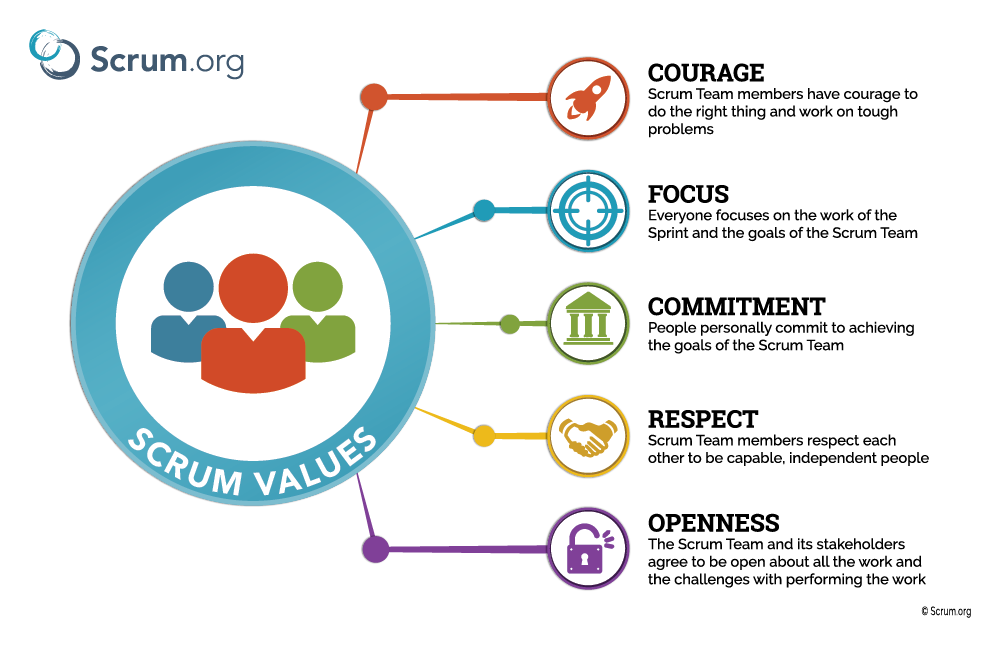
- Courage (Courage) – Scrum team members dare to do the right thing and tackle complex problems.
- Focus (Focus) – Everyone focuses on sprint tasks and team goals.
- Commitment (Commitment) – Personal commitment to Scrum team goals.
- Respect (Respect) – Scrum team members respect each other as capable, independent individuals.
- Openness (Openness) – The Scrum Team and key stakeholders are continuously open and transparent about the status of work and challenges.
https://guntherverheyen.com/2013/05/03/theres-value-in-the-scrum-values/
It doesn't matter how good you are today; if you're not better next month, you're no longer agile.
- Mike Cohn, Agile trainer and author

Every new contact is an opportunity for new and exciting collaboration - write or call me, and let's discuss how I can help you.
The first consultation and proposal are always free.