



Merle Randlepp
Agile Coach
Merle Randlepp
Agile Coach
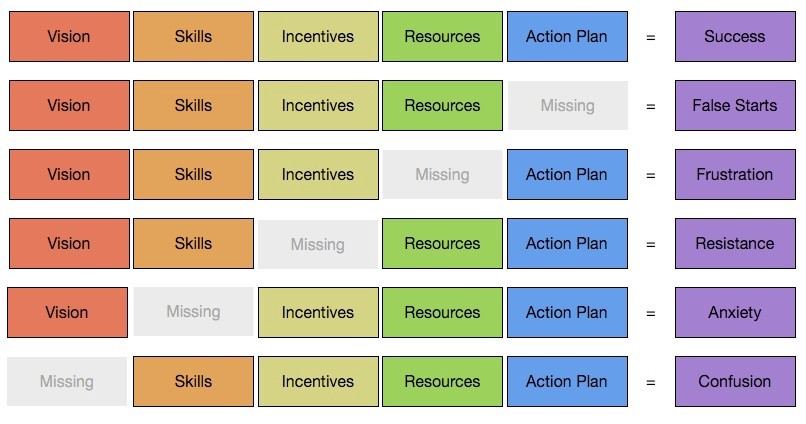
What is the Knoster model?
The Knoster Model [1] is a simple and powerful tool for those who need to manage important changes – project managers, team leaders, company leaders, etc. The model is useful if you want to understand how people psychologically adapt to change and how they cope with major changes in everyday life.
To be effective, you need at least five components. If any of these components are missing, the implementation of the changes will most likely fail. Why? Here are the reasons.
Why does it work?
VISION
People need to know why they are moving forward.
Otherwise, there will be CONFUSION that arises due to a lack of vision and direction for the future.
SKILLS
Everyone involved must have the skills to become successful. Otherwise, ANXIETY arises in those who feel that they do not have the necessary knowledge or experience to deal with new situations.
INCENTIVES
Humans are naturally resistant to change. You have to find what motivates people internally, otherwise there will be RESISTANCE from those who don’t see anything useful in the changes and can’t find any moral meaning to it.
RESOURCES
All the things that people consider necessary to make changes.
In the absence of these, FRUSTRATION arises because there are no resources to adequately implement the changes.
ACTION PLAN
Great leadership, energy, a lot of money and an inspiring vision are not enough if you don’t have a concrete plan of action.
In the absence of this, there will be FALSE STARTS when we try to do in a new way what we have always done.
How to use it?
I have experienced several organizational changes where some of these elements were not given enough attention (usually vision or incentives) and too often resulted in an arduous pace of change and resistance from many people who did not understand WHY they should implement this change in the first place and (sub)consciously sabotaged all management efforts.
Here are some questions that are worth asking from time to time to see if everyone is in the same boat:
- Vision – Why are we making this change? Why is it good? What will the future look like?
- Skills – Do we have the know-how to implement?
- Incentives – Are we all willing to do this? What benefits do we get from it?
- Resources – Do we have the time, money, and people to do it?
- Action plan – What steps need to be taken? Who does what?
I wish you success in managing change!
—
[1] T Knoster, Presentation to TASH Conference, Washington DC, 1991.
Related topics
How to conduct a Scrum Retro meeting?
I am often asked how to conduct a Scrum Retro meeting correctly so that people would be happy to participate next time as well. And this is a very correct question, because if you conduct a Retro meeting in an incompetent way, it will most likely go wrong and people will have a traumatic experience instead of the expected benefit. However, a successful Retro meeting is extremely useful. Here you will find a detailed step-by-step description of how to carry out your first Retro or, if you have already done them before, you may find new useful tips.

How to measure the work of a Scrum Master?
How do you know that the Scrum Master of the development team does his job well? The success of a Scrum Master’s work cannot be judged on the basis of a few numerical values, but I will give you 5 main success criteria to follow.

Agile Trends 2021
The unforeseen events of 2020 have shown the importance of adapting quickly to a changing environment and taking an agile approach. Agile trends in 2021 reflect the global economic situation and adaptation to the new needs of a changed world. Below, I will highlight the TOP5 agile trends that we will see more and more in the past and in the coming years.


Every new contact is an opportunity for new and exciting collaboration - write or call me, and let's discuss how I can help you.
The first consultation and proposal are always free.