



Merle Randlepp
Agile Coach
Merle Randlepp
Agile Coach
What is the RICE model in product development?

In product development, we never have enough time or resources to implement all desired initiatives. Product owners constantly evaluate which developments to pursue and which to postpone, and making the right decisions is far from easy. The RICE model helps us make faster and more accurate decisions when prioritizing tasks. In this blog post, I will discuss the usefulness, structure, adaptation, and implementation of the RICE model. Here you will also find several tools: a RICE model table, workshop instructions for creating the model, and a model cheat sheet.
The art of prioritization is one of the most critical activities in product development. However, we should not pose the question as “Is this development idea good or bad?” but rather “Which sequence of development tasks creates the most business value?”.
Therefore, it is important to use a specific prioritization method in product development and not rely solely on gut feelings when making decisions. There are many different prioritization techniques, and the RICE model is one of the most popular in software development.
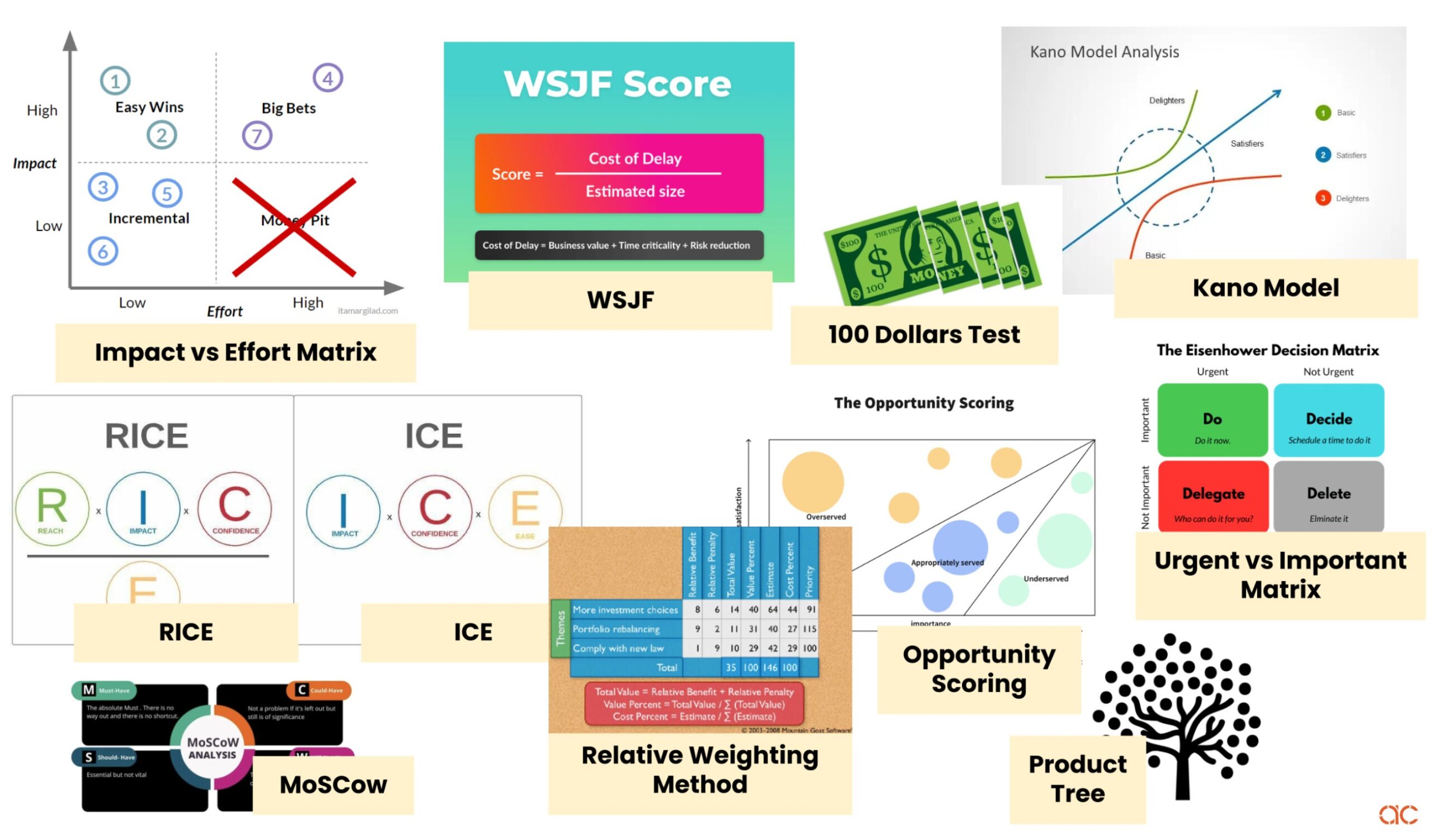
Different prioritization methods. Image by author.
Why is the RICE model useful?
Setting priorities is a complex task because there are so many different factors to consider. We must consider the interests of our clients and end-users, the business interests of the company, as well as technical aspects such as innovation, speed, reliability, and more.
With so many different factors, it is natural that without a clear method, discussions can take an unreasonable amount of time, and ultimately, there is still no certainty about the correctness of the decisions made.
Too often, I have seen a list of development tasks (Product Backlog) whose top consists of about 50 tasks with a “high” priority. How then to choose which of these 50 tasks to tackle next? Many prioritization methods only help us categorize development tasks (e.g., high/medium/low priority), but they do not provide us with the order in which tasks should be performed.
Furthermore, comparing development tasks often seems like an “apples and oranges” problem, because qualitative assessments are difficult to provide and justify.
Therefore, if we find a way to put qualitative information into a numerical model, it will help us achieve our ultimate goal: to determine the best order for development tasks.
For this, there is no need to create an overly complex model that considers dozens of different factors. There is a much simpler way, and that is the RICE model adapted to your needs.
What is the RICE model about and when to use it?
The RICE model was first proposed by Intercom Product Owner Sean McBride in the mid-2010s.
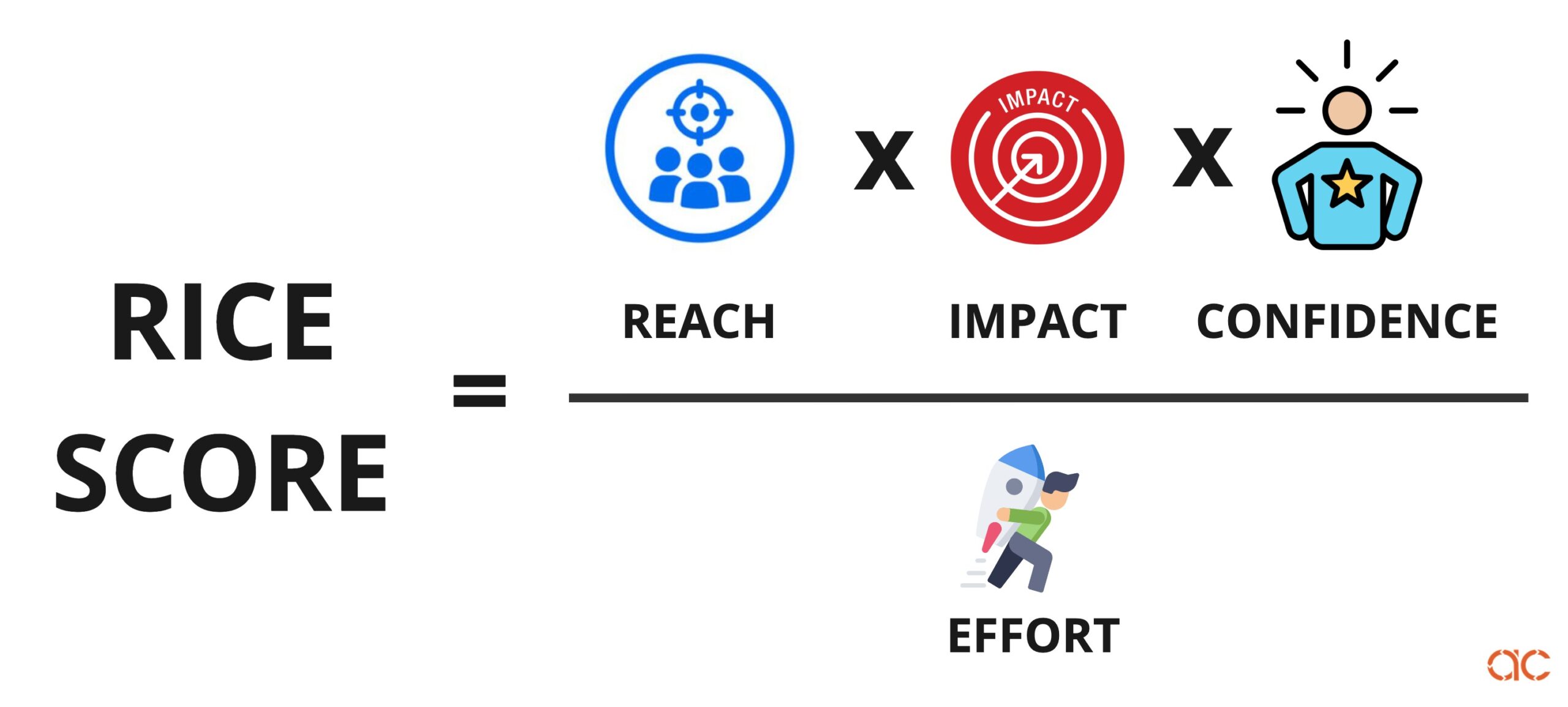
The RICE model quickly gained significant popularity, and over the years, it has been simplified, supplemented, and adapted in various ways. That is why you will find quite a few different versions when searching for “RICE prioritization,” “RICE model,” or “RICE method.” However, the fundamental core has always remained the same – the RICE model consists of four main factors, from whose initial letters the model’s name is derived:
- REACH – How many people does this affect?
- IMPACT – How much does this affect? What is the magnitude of the impact?
- CONFIDENCE – How confident are you in the estimates for the previous two factors (REACH and IMPACT)?
- EFFORT – How much effort does this require?
The RICE model is sensible to use only for prioritizing tasks over a longer period – 1 quarter to 3 years. Prioritization with the RICE model does not replace sprint planning or sprint task estimations.
RICE Prioritization Example
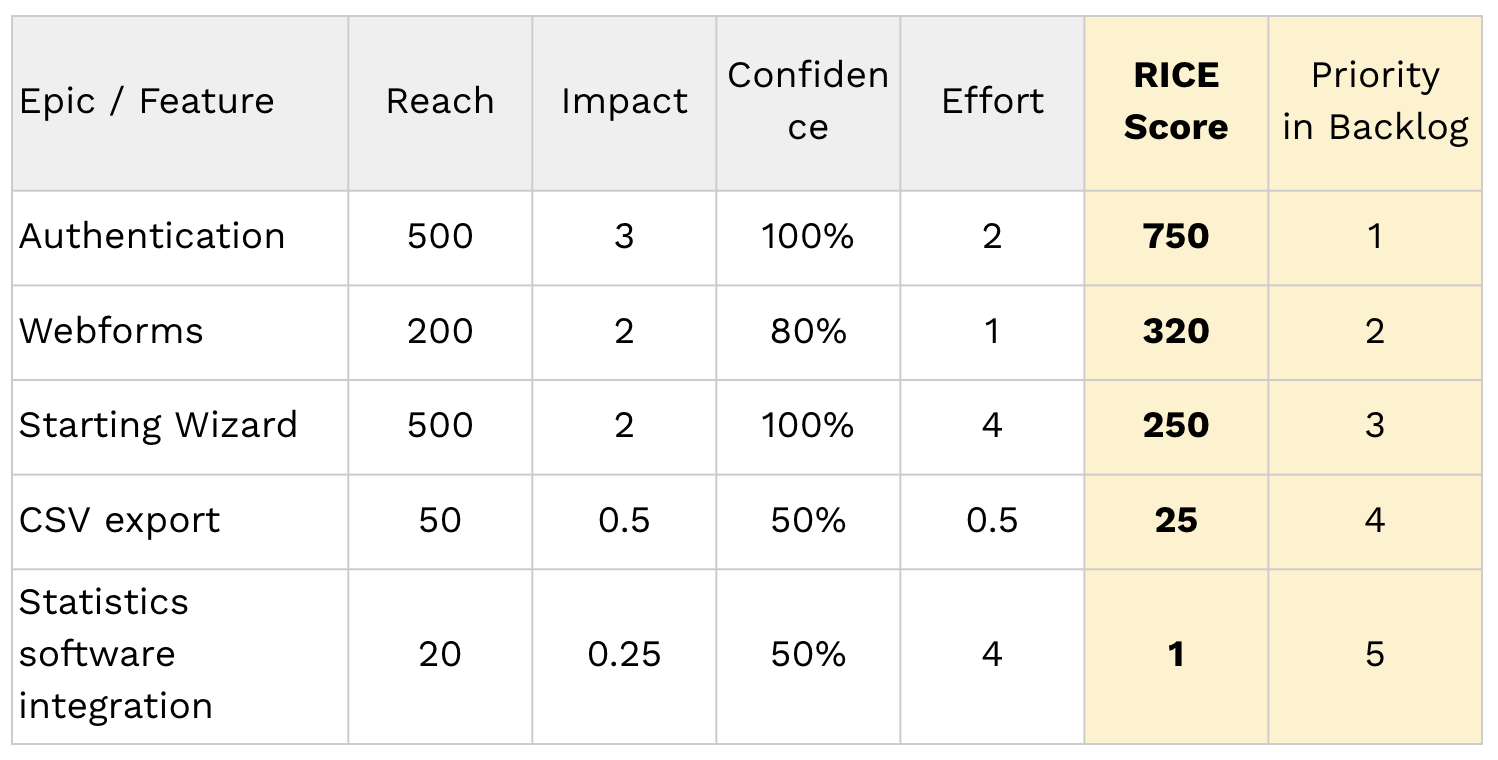
RICE model example. Image by author.
Using the RICE model also helps save time spent on task analysis.
Ideally, the RICE score should be assigned to a task BEFORE detailing and breaking down the work (story slicing).
If RICE scores are assigned to tasks early, we do not unnecessarily waste time analyzing tasks with too low a RICE score, as it is quite possible that this task will not be started anytime soon or it will be decided later not to do it at all.
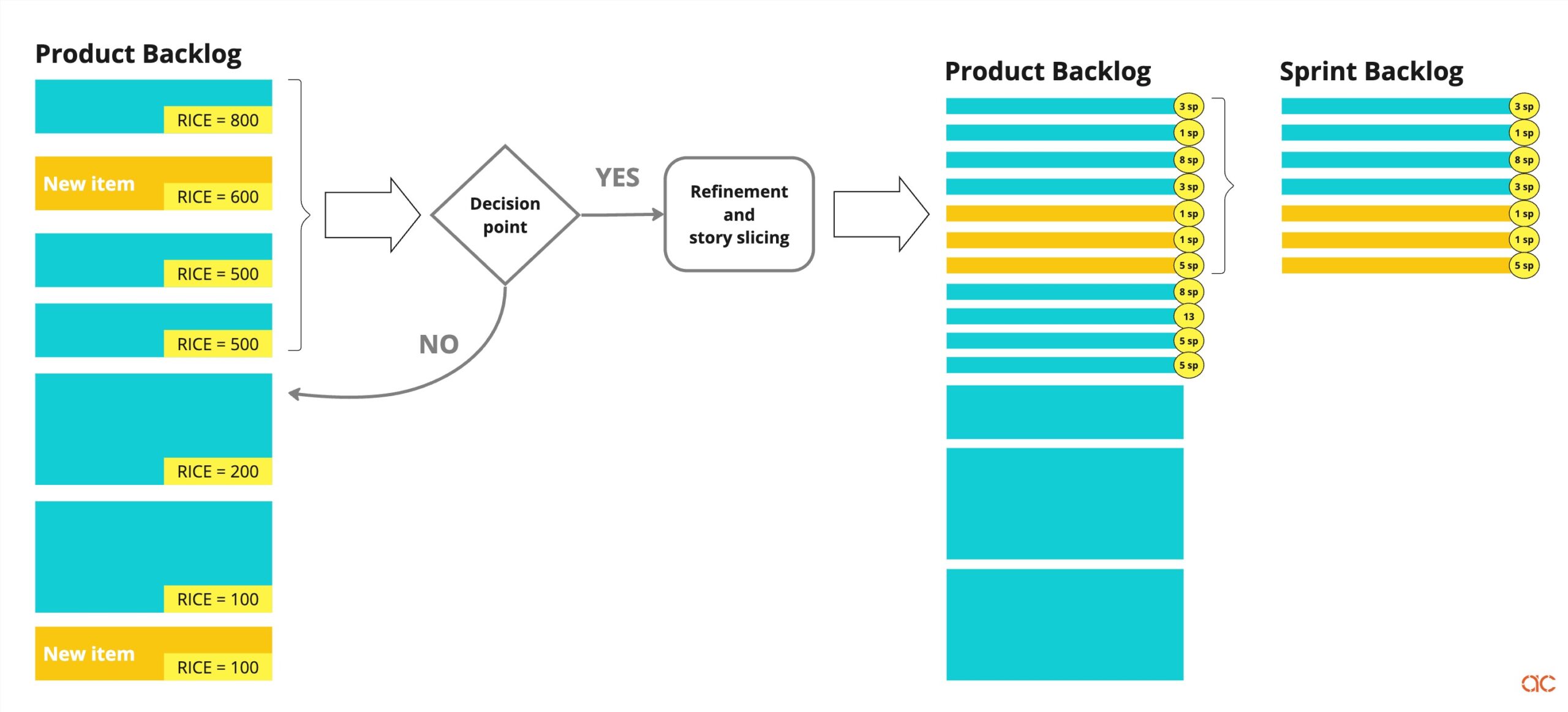
Example of using the RICE model in the Scrum development framework. Image by author.
Adapting the RICE Model
As mentioned earlier, the original RICE model has been adapted in various ways, and every company that wants to implement the RICE model should do the same. Here are some options you can consider when making your choice, but these are certainly not the only possibilities.

REACH – How many people does this affect?
Option A: Simple Scale
- 4 – all current users of your product
- 2 – some current users of your product
- 1 – new users who are not yet using your product
Option B: Number
- Number of customers who will start using this feature (e.g., 500, 3000)
- % of all customers who will start using this feature (e.g., 500*30%=150)
Option C: Number + Time Period
Number of customers reached within a certain period (month, quarter, year)
Option D: Customer Weights
Weights:
- 0.5, 1, 2, 4, 8 (powers of two) or
- 1, 2, 3, 5, 8 (Fibonacci)
This feature is needed by:
- 8 – Very important customers, i.e., key/anchor clients (e.g., revenue 10,000+ EUR)
- 4 – Important customers (e.g., revenue 5…10k EUR)
- 2 – Medium importance customers (e.g., revenue 1..5k EUR)
- 1 – Low importance customers (e.g., revenue 0.1…1k EUR)
- 0.5 – Very low importance customers (under 100 EUR)

IMPACT – How much does this affect? What is the magnitude of the impact?
Use fixed values:
- 3 – Massive impact
- 2 – High impact
- 1 – Medium impact
- 0.5 – Low impact
- 0.25 – Minimal impact

CONFIDENCE – How confident are you in the estimates for the previous two factors (REACH and IMPACT)?
Use fixed values:
- 100% – High confidence
- 80% – Medium confidence
- 50% – Low confidence
- 20% or less – No idea

EFFORT – How much effort does this require?
Option A: Simple Scale
- 4 – High effort (12+ person-months)
- 2 – Medium effort (3..12 person-months)
- 1 – Low effort (1..3 person-months)
- 0.5 – Trivial effort (less than 1 person-month)
Option B: Number
Number of person-months required for development, considering the entire feature lifecycle.
For example:
- 2 weeks of planning + 2 weeks of design + 4 weeks of programming = 2 person-months;
or - 4 people x 3 months = 12 person-months
Calculation Formula
The RICE score calculation formula is: (Reach x Impact x Confidence) / Effort
How to start using the RICE model?
As a first step, you need to develop a RICE model that suits your organization’s needs. For this, I recommend organizing a product owner workshop where you can discuss the model’s factors and validate the model itself. You should allocate at least 2 hours.
The most challenging part is finding a suitable Reach factor. Impact and Confidence are already fixed values, so you don’t need to figure anything out yourself here. You also need to decide which is the most suitable option for the Effort factor.
If necessary, you can add further detail to each RICE model factor, but I recommend keeping the model simple. The REACH factor should consist of one, two, or at most three factors. A simple model is more challenging to develop initially, but later it is easier to remember and use.
Be sure to validate different model variants using specific development tasks. Here you can use the RICE model table template, which you can modify as needed. Analyze whether the resulting RICE scores are valid. If, for example, the REACH values are the same for all development tasks, this could be a warning sign that the inputs in their current form are not working and need further refinement, or alternatively, new and more diverse development tasks should be added for validation.
At the end of the workshop, write down your team’s agreement on using the RICE model. If you don’t reach an agreement immediately during the first workshop, don’t despair – creating a suitable RICE model is indeed a complex task. You can conduct additional analysis and then organize a follow-up workshop.
Regardless of which model you use, make its application consistent across all teams in your organization. Multiple different RICE models within the same organization can cause significant confusion.
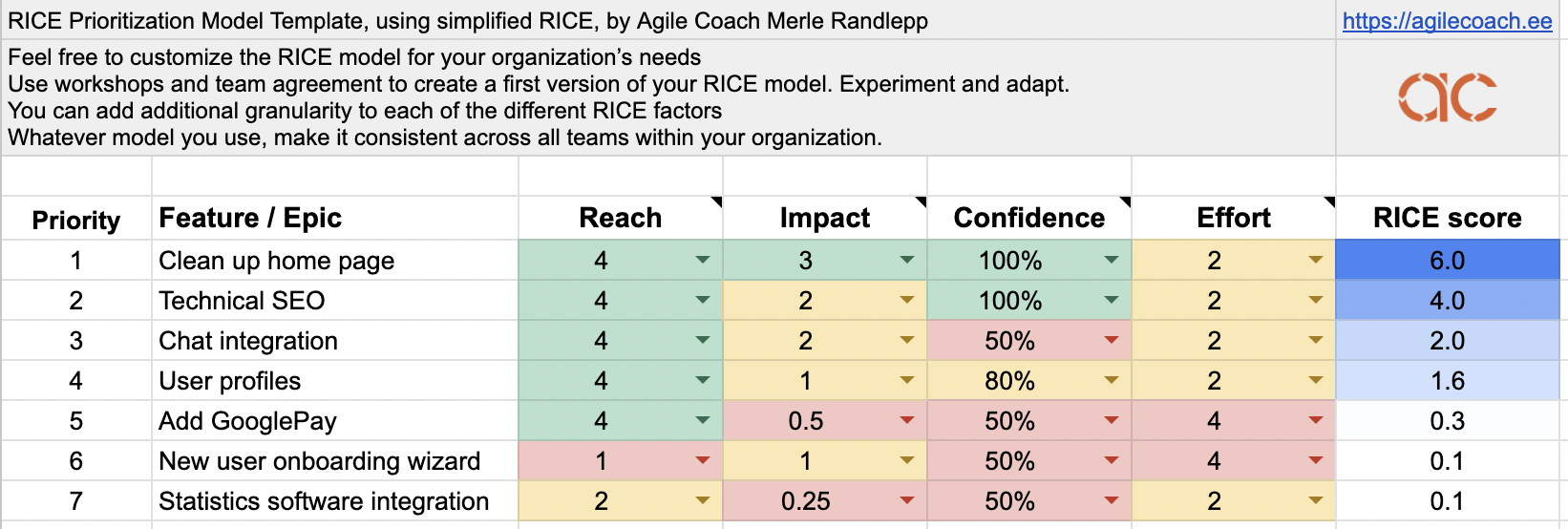
RICE model table template. Image by author.
Tools
Here you can download the RICE model development workshop instructions, a table for model validation and future use, and a RICE model cheat sheet.
Download RICE Prioritization Model Workshop instructions (pdf)
Open and make a copy of RICE Prioritization Model Template (Google Drive)
Download RICE Prioritization Model Cheat Sheet (A4 PDF)
Summary
If you are a product owner who needs to assess the business value of various development tasks and create a long-term roadmap, then the RICE model will help you set task priorities more easily and make more accurate decisions in the long run.
You can always start experimenting with RICE prioritization using the classic model, where:
- Reach is the number of customers who will start using this feature
- Impact is the magnitude of impact on a fixed scale
- Confidence is the certainty of the Reach and Impact assessment, again on a fixed scale
- Effort is the number of person-months required for development
If the classic model does not seem suitable, then collaboratively work with your team to develop a model that fits your specific needs. You can find the necessary tools in this blog post.
Which prioritization technique do you use today? Share your thoughts in the comments.
Related topics

IT Manager Metrics: Framework + Lead Time vs Cycle Time (1/3)
A clear framework for measuring the IT team and core speed metrics from a single page: what is the difference between Lead Time and Cycle Time, how to set a start-end rule, and when to use each.

The 8 Biggest Mistakes of a Product Owner
The role of the Product Owner is the most important role in a software development team. This role is far from easy, the area of responsibility is large and varied, the workload is usually as well, and so it may happen that “the seams start to burst” somewhere. I have compiled eight of the most common mistakes made by product owners that have the greatest impact in product development.

Agile mindset and myths around it
The term “agile” has probably been heard by many people in different contexts – talking about dog training, talking about IT and software development, organizational management topics, and more. I will write down 9 myths that circulate around the term “agile” and that I have often encountered in my work.


Every new contact is an opportunity for new and exciting collaboration - write or call me, and let's discuss how I can help you.
The first consultation and proposal are always free.
0 Comments