



Merle Randlepp
Agile Coach
Merle Randlepp
Agile Coach
Who is a Scrum Master? An agile project manager?
Scrum Master in the Estonian landscape
Quite often, I see the following scheme in Estonian software development projects: the development company describes in its offer in eloquent terms that they develop agilely and use the Scrum methodology. The team’s description states that the role of Scrum Master is performed by the project manager. Looks okay?
But this is where the fundamental problems begin. I myself have been in the role of a project manager and a Scrum Master at the same time, and I have lived through all the painful personality split problems that such an arrangement has caused.
I’d better say right away that a Scrum Master is NOT an agile project manager.
Readers working in digital agencies or development companies are probably starting to close this story now, because everyone knows that it is simply not economically feasible to add another separate person to the team in addition to the project manager. Yes, I know that and I agree with you. But read on.
Readers working in large agile companies are probably more understanding and have encountered this topic before. They have people in the role of a separate Scrum Master divided into several teams and their tasks do not coincide with those of a project manager. However, there are only a handful of such large companies in Estonia.
I want to show you what the role of a Scrum Master is, how it differs from the role of a project manager, and who could fill it in a team.
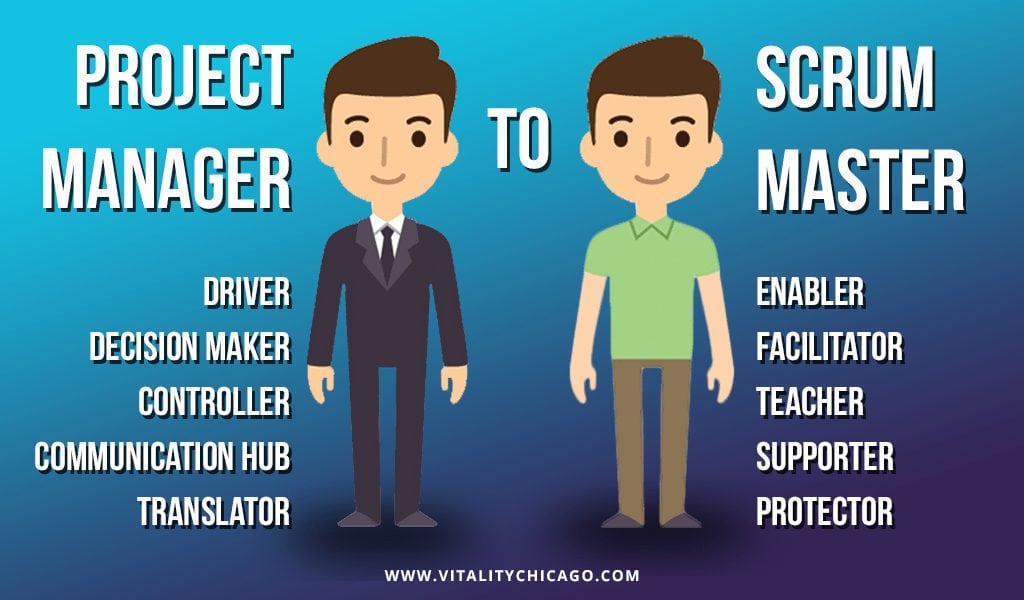
Different roles
It is true that the skills of a Scrum Master and a project manager overlap to some extent, which is why it is so easy to put them together. But their purpose and motivation are different.
To put it very simply, it can be said that:
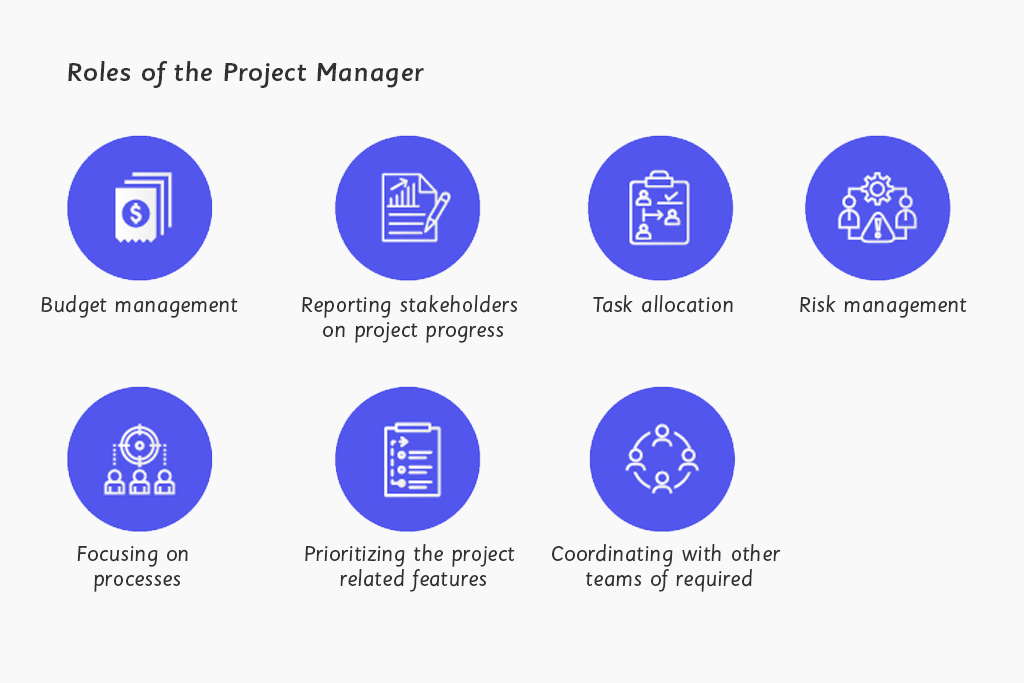
- The project manager deals with the management of the schedule, scope, budget and resources, including change management, quality management, risk management, communication between the client and the executor, reporting on progress, organizing meetings, etc.
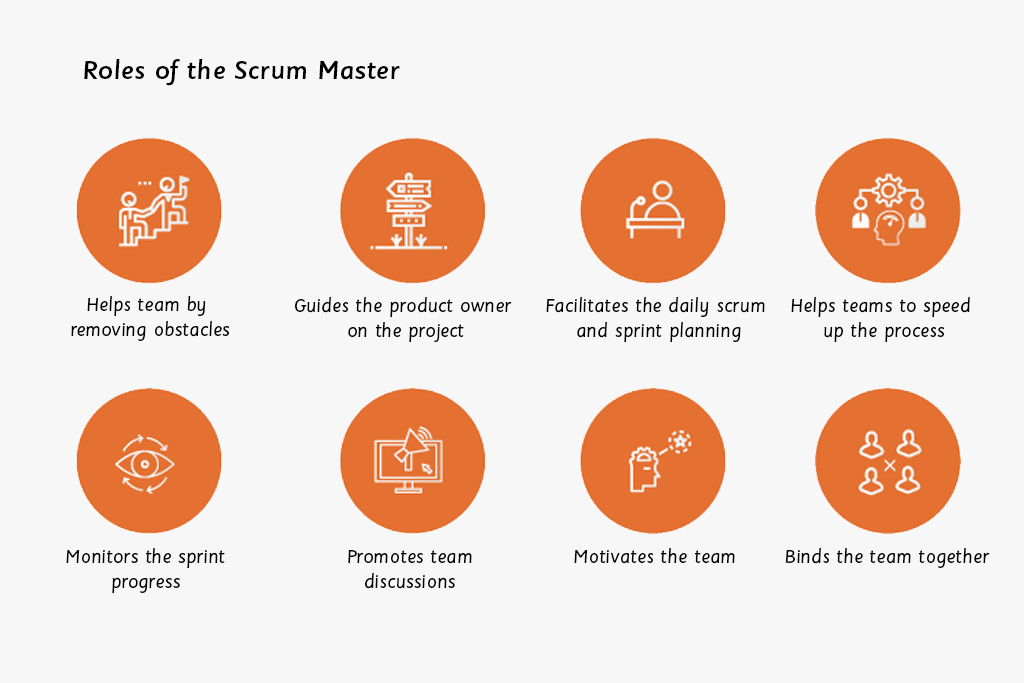
- The Scrum Master is responsible for the quality of the development process, his task is to create a maximally effective Scrum team that uses Scrum practices in the best way. He is responsible for teaching Scrum to team members, conducting Scrum events (planning, review, retro), mentoring and support.
Scrum Master Tasks
- To be a teacher – to teach team members agile values and principles, as well as the application of the Scrum framework.
- Be a coach – have the necessary conversations with team members, product owners, managers, customers, and other people to help them better understand Scrum and its value.
- Be a facilitator – help manage and carry out Scrum events, such as Sprint Planning, Sprint Review or Sprint Retrospective. This does not mean organising the practical side of the meeting. This means preparing, guiding and empowering people during the meeting.
- If necessary: be a servant leader – lead the implementation of agile principles in the organization, working with all different stakeholders (employees, managers, customers, council, etc.).
Tasks of a project manager
- Manage changes (scope, schedule, and budget)
- Project Team Management
- Manage your schedule
- Requirements Compliance Management
- Measuring project progress
- Quality management
- Risk management
- Administrative activities and reports of the project
- Managing communication in a team
Why not put the role of Scrum Master and project manager in the same person?
The reason lies in the psychological conflict, which appears already in the first stressful situation. One and the same person should not be held responsible for HOW the work is done and WHAT is done, because as soon as there is pressure from the business side, the person has to choose – whether to go HOW or WHAT to do. Usually, they go for WHAT you do, which in turn leads to a decrease in the quality of the work of the entire team, and in the end, no one wins from it.
It is this aspect – how important is HOW the work is done – that is often not brought to the managers and not carried out. And this is a great pity, because if the team has the opportunity to develop more or less in the same composition and get the most out of Scrum practices, then they are not just effective, they are ROCKETS. What leader wouldn’t want a team with rocket speed? But the road to it takes time (one-time time!) and requires the guidance of a skilled Scrum Master.
Who could fill the role of Scrum Master?
It can be anyone in the team who has enough Scrum experience and the ability to understand and guide people. It can be a lead developer, analyst, designer or architect, a Scrum Master appointed by the company who works in several teams at the same time, or an external consultant. Yes, you can even be a project manager, but then you have to be thoroughly aware of the internal conflict and try not to sacrifice quality under pressure.
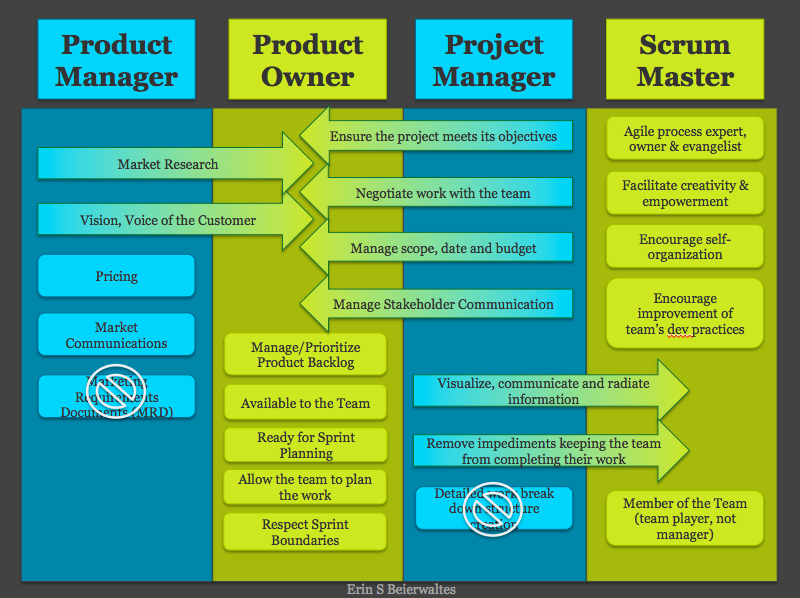
The last point – the biggest difference between a Scrum Master and a project manager
The biggest difference between the role of a Scrum Master and a project manager is the duration of the mission. A project manager is needed from the beginning to the end of a specific project, without breaks. However, the mission of a Scrum Master is to make yourself unnecessary. The work of the Scrum Master with the team ideally lasts 2-4 months, after which he or she can leave the team and move on (if it is an external team member), because the team is independent, self-acting and no longer needs the support of the Scrum Master.
If the Scrum Master role was filled by an internal Scrum team member, then it is time to give other team members the opportunity to practice the skills of the Scrum Master role. Such an opportunity is extremely inspiring and developing. In this way, an experienced Scrum team becomes a breeding ground for new Scrum Masters.
On the other hand, in the continuous development phase, I have encountered agile teams where there is no project manager at all, because the team is so self-sufficient that the project manager simply has nothing to do there. Of course, these teams have been together for a long time – more than 6 months. Such teams work extremely efficiently and are every developer’s dream 🙂

What a Scrum Master Should Know
- The ins and outs of the Scrum Framework
- Phases of team development (forming, storming, norming, performing)
- When to use teaching, when to use coaching, when to use mentoring
- The Shu-Ha-Ri Method for Learning New Techniques
- That your job is never to “force through” topics, but to be a servant leader
- That tracking the team’s KPIs (e.g. velocity) is helpful, but not necessarily decisive
- So that it would be good for the Scrum team to get feedback directly from the management and not only through the Product Owner
- jpm 🙂
Summary
In summary, the Scrum Master’s mission is to transform the development team into a high-level agile team that not only follows the Scrum framework, but who uses an agile mindset in all their decisions. The project manager often has an internal conflict with this role, because the focus is always more on organisational issues and the steps necessary for development are not reached in the fast pace of everyday life. Therefore, it would be more appropriate to assign the role of Scrum Master to someone else who has the interest and necessary prerequisites for it.
On the other hand, it is true that it is often the position of a project manager who develops into a Scrum Master. When you reach a certain level, the difference in roles starts to interfere with the project manager’s work and a change must be made.
A good Scrum Master can only be achieved through experience. Experiment, experiment and analyse the results consistently. This is the only way to develop to reach the level of a dream team.
See also: What is the difference between a Scrum Master and an Agile Coach?
Related topics

IT Manager Metrics: Framework + Lead Time vs Cycle Time (1/3)
A clear framework for measuring the IT team and core speed metrics from a single page: what is the difference between Lead Time and Cycle Time, how to set a start-end rule, and when to use each.
What is the RICE model in product development?
In product development, we never have enough time or resources to implement all desired initiatives. Product owners constantly evaluate which developments to pursue and which to postpone, and making the right decisions is far from easy. The RICE model helps us make faster and more accurate decisions when prioritizing tasks.

The 8 Biggest Mistakes of a Product Owner
The role of the Product Owner is the most important role in a software development team. This role is far from easy, the area of responsibility is large and varied, the workload is usually as well, and so it may happen that “the seams start to burst” somewhere. I have compiled eight of the most common mistakes made by product owners that have the greatest impact in product development.


Every new contact is an opportunity for new and exciting collaboration - write or call me, and let's discuss how I can help you.
The first consultation and proposal are always free.